Organisational Change
Change - Change Management = Epic Failure
Albert Wienand · 2026/06/09
When you've managed programmes and projects for as long as I have, you'll have seen a fair few successes and a few failures also. Failure lends valuable data, often more so than success, yet my favourite author, Douglas Adams, said it best: "Human beings, who are almost unique in having the ability to learn from the experience of others, are also remarkable for their apparent disinclination to do so."
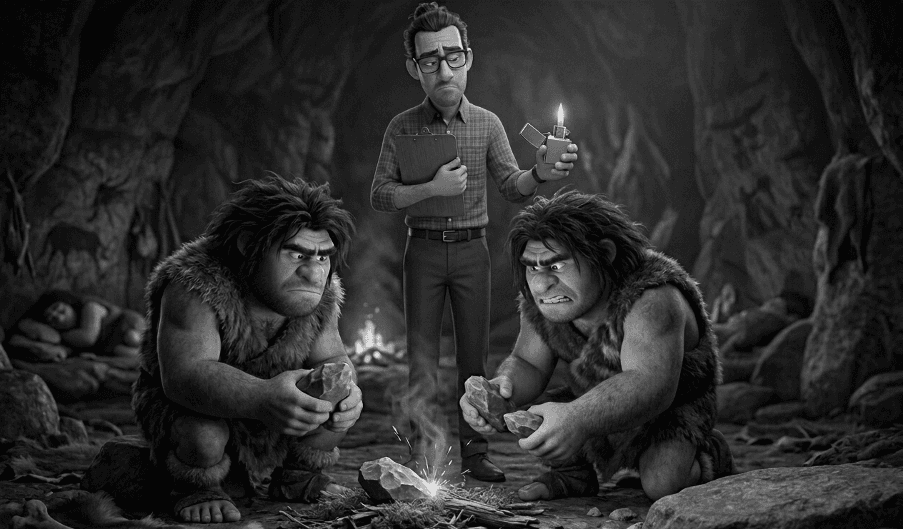
A pattern that I've seen repeated in every decade I've worked in is that, quite frequently, nobody prepares the people for the changes that the project would bring. And so when it arrives they are either like a deer in the headlights of a careening vehicle, or they simply quietly refuse the change, and a project that looked triumphant in the boardroom dies a death by a thousand cuts in operations.
This isn't an AI problem, despite the narrative in the market. This problem is as old as work itself. Long before the advent of AI, projects frequently succeeded or failed on one unglamorous variable: whether the teams expected to live with the change were ready for it, brought along for it, and taught how to do their jobs once it arrived.
There's an equation under all of it, and it predates every tool I've ever implemented. Change minus change management equals epic failure. AI hasn't rewritten that equation. It's just the loudest and most expensive place we're currently relearning it. There are three tenets ignored at any project's peril.
The first tenet is that you can't drop change into an organisation that isn't ready for it and expect the readiness to show up on its own. Enthusiasm at the top is not preparedness on the floor. A team that's already stretched or already half-convinced that this new thing is a threat dressed up as progress is not a team that's amenable to anything, no matter how good the pitch sounded upstairs. Structure before AI, the line I keep repeating, is really just the current version of a much older idea: Structure before anything.
The second tenet is that you either take people along for the journey, or risk them wanting nothing to do with your destination when you get there. Organisational culture, like nature, abhors a vacuum. If people aren't told what's coming next, they'll fill that silence themselves, and more often than not with a story you would not have chosen. AI has only made the invented story more frightening, because now the scariest version available (I'm being automated out of a job) is also the most believable one going. If you bring people in early, show them the why and the what, let them see a staged path instead of a single cliff edge, the very people who might have sabotaged the rollout become the ones defending it.
The third tenet is training on the new way of working. It's simple, really: if you change how the work gets done, you change the job itself. The shape of someone's day is different now. Where they used to do a thing, they might now check it, or correct it, or decide whether the output is good enough to send. Asking people to be good at something new on day one is a push. Asking people to be good at something they were never taught on day one, well that's just not going to happen.
The reason I'm bothering to say all this now, in the middle of the AI noise, is that the noise has a lot of clever people convinced the old rules are suspended, that this change is so different it must play by different laws. It isn't, and it doesn't. AI raises the stakes, since the systems are more capable, the spend is larger, and the disappointment lands harder, but it doesn't suspend a single one of the tenets that decided whether change stuck back when the newest thing in the building was an ERP rollout or a redrawn branch network. Now, it just punishes their absence faster.
So if you're standing at the edge of an AI rollout, the real questions are the same ones a good change leader would have put to you a decade ago about any change worth the name.
- Are your people ready?
- Do they know why?
- Have you taught them the new way of working?
Get those three right and the technology, AI or otherwise, becomes significantly easier to manage. Get them wrong and the most advanced model on earth will die in operations alongside every unprepared change that came before it.
We don't build software, we build systems that make a business compound, and the problem we're solving has never been a technology problem in isolation.
It's a people problem wearing a technology costume.